There are so many things to know about what baby needs. You will get a ton of hand-me-downs like I did. I was thankful and overwhelmed at the same time. Yet, I found that things eventually I needed were somewhere so it helped to have everything organized at least by category before the baby.
Feeding
Like make things baby-related, we tried multiple bottles, figured out what worked for baby and moved on.
Bottles
- Straight from the hospital, we used the Philips AVENT Natural Baby Bottle with Natural Response which we stopped using fairly quickly because the milk came out too slow for our hungry baby
- Dr. Brown’s Natural Flow Anti-Colic Options+ Narrow Baby Bottle, 8 oz/250 mL, with Level 1 Slow Flow Nipple, 0m+
- You need different size nipple as the child grows older:
- Dr. Brown’s Bottle Preemie Nipples
- Dr. Brown’s Level 1 Slow Flow Nipple
- Dr. Brown’s Bottle Level 2 Nipples (3+ Months)
- Dr. Brown’s Bottle Level 3 Nipples (6+ Months)
- Dr. Brown’s Bottle Level 4 Nipples (9+ Months)
- Dr. Brown’s Bottle Level Y Nipples (9+ Months)
- You need different size nipple as the child grows older:
Burp cloths, burp cloths, burp cloths!
It seems you can never have enough burp cloths!
- We got a whole bunch of burp cloths from Korea from my mom’s most recent Korea trip. It feels like mom is still taking care of us from heaven.
- Muslin Burp Cloths 100% Cotton Baby Burp Cloths Soft, Absorbent 10×20 inches for Girls and Boys Baby Essentials
Sleeping
Mattress

Sleepwear
We got so lucky with a baby that slept well! Even still, we tried all different kinds of swaddles and sleep sacks because babies have preferences like all humans.
Things I googled about swaddles:
- What does swaddling mean?
Swaddling refers to the practice of wrapping a baby snugly in a blanket or cloth, with their arms and legs securely contained. This technique can help calm babies and promote better sleep by preventing sudden movements that might startle them awake. - How to transition out of swaddle?
Transitioning out of swaddling is a gradual process. You can start by swaddling with one arm out, allowing your baby to gradually adjust to more freedom of movement. Over time, you can transition to both arms out or move to a sleep sack, which provides the cozy feeling of being swaddled while allowing more mobility. (Source: Halo.com) - What is TOG?
TOG (Thermal Overall Grade) is a way to measure the warmth of baby sleepwear like sleep sacks, wearable blankets, and swaddles. It tells you how well a material traps heat to keep your baby cozy. The higher the TOG rating, the warmer the sleepwear—making it perfect for colder nights. Lower TOG ratings are better for warmer temperatures. Keep an eye on the room temperature and adjust the TOG as needed to keep your baby comfortable.
Sleepwear Transition
Swaddle blanket –> sleepsack swaddle –> sleepsack
Weeks 1 – 3: Swaddle Blanket
We used these nice and soft swaddles as soon we got home from the hospital. I like that you can eventually use these for other things like as a burp cloth. We use these as blankets in the bassinet for when we go out.
Weeks 3 – 6: Swaddle
Our baby had kicked a lot in the womb and those same kicks undid the swaddle several times. We had to use another swaddle we were gifted.
Weeks 7 – 11: Sleepsack Swaddle
Our baby was born big and so he quickly grew in weight and height by 2 months. We love the microfleece HALO Micro-Fleece Sleepsack Swaddle, TOG 3.0 because of the quality and that it is both sleepsack and swaddle.
He quickly outgrew the 0-3 months, which is the last version with the swaddle. I guess they assume young babies do not get that big.
Available sizes for Halo are:
- Preemie, Newborn,
- 0-3 months (with swaddle)
- 3-6 months (no swaddle)
- Small, Small/Medium, Large
I was on the hunt for a new sleepsack swaddle similar to the Halo. I found a sleepsack swaddle for 6 – 12 month olds. Many reviewers with large babies used it after their baby outgrew the Halo.
At 6 months, we transitioned Evan to sleep sacks with feet because he would constantly kick out of the swaddles. He’s still wearing these at 14 months old so it was a great buy for us:
- Toddler Sleep Sack 12-24 Months 100% Cotton Lightweight Baby Sleep Sack with Feet
- Toddler Sleep Sack with Feet TOG 0.5 Baby Wearable Blankets with Legs Sleeveless Baby Sleeping Bag for Boys Girls, 2 Pack
Baby cam
- We use the Nanit, which offers a wall mount or floor stand:
- Nanit Pro Smart Baby Monitor + wall mount
- Nanit Pro Smart Baby Monitor + floor stand
- Pros: it has great picture quality, 4 different sounds like white noise that we use daily, and great for both parents to access from our phones even while traveling. It logs the time the baby sleep, any crying, temperature, and humidity
- Cons: it detects sounds and movement a little too well and inaccurately logs my baby’s activities often. For example, it might show that Evan woke up multiple times throughout the night based on his occasional twists and turns. It might also detect the wind and log that a “caretaker attended” to him, which isn’t true. It’s not a huge issue because I use it for his sleep and wake up times, which is when we put him in and out of the crib.
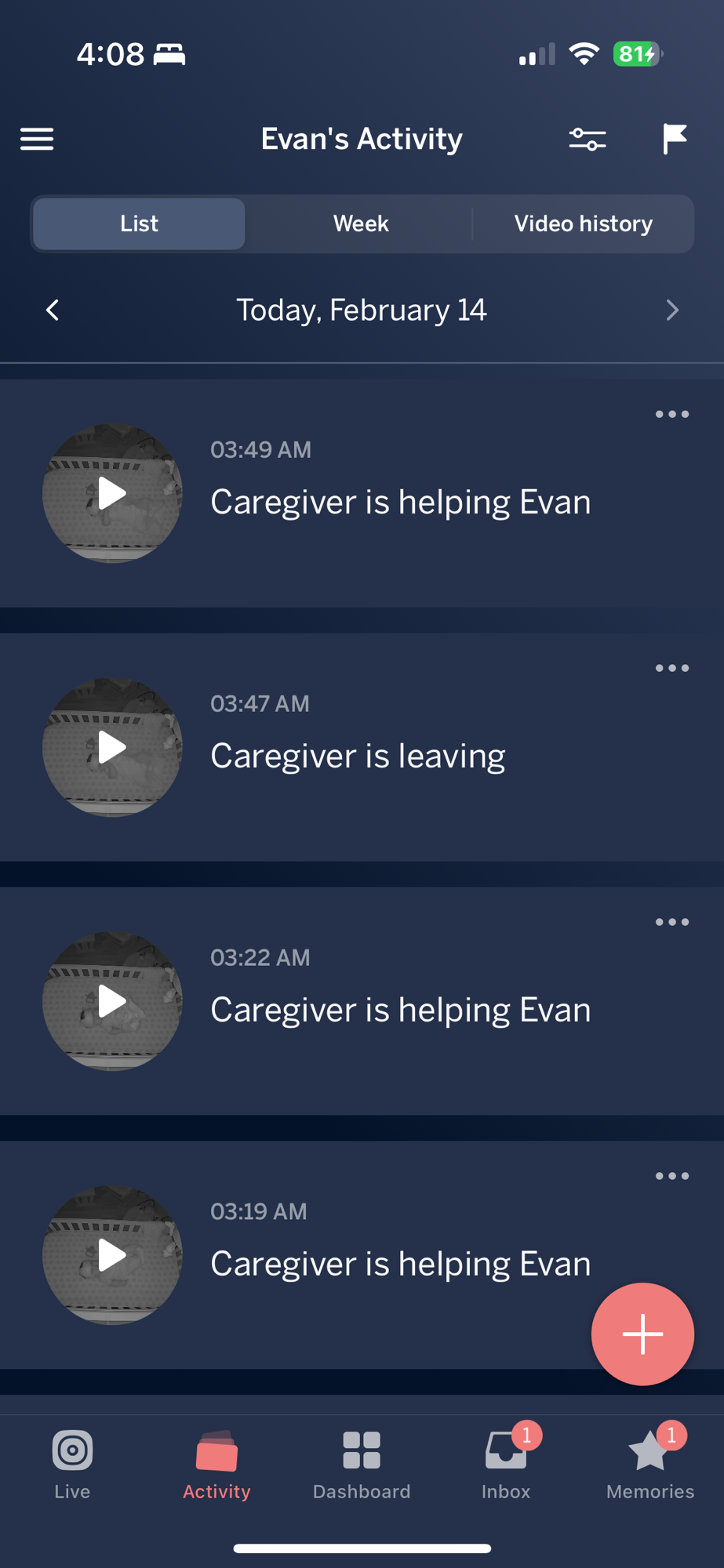 Really Nanit? We did not go into his room, and definitely not this many times! Maybe it’s best to keep the crib/camera further away from the window.
- We also got a portable travel camera with no WiFi that we use for trips: HelloBaby Baby Monitor with Camera Audio and Video, 6″ World First IPS Screen 30H Battery, Secure No WiFi, Pan Tilt, Night Vision, VOX/ECO, 2-Way Talk, 1000ft, Portable Travel
Nursery
Eczema
See post. I am keeping a running list of products we’ve tried and used. Nothing has been working yet, so we will have to go see a dermatologist and/or allergist soon.
Cleaning
We wash baby’s face, hands, and neck (smells like cheese!) every day to moisturize him. Here are the items I used almost every day until 6-8 months:
- We use the oogiebear for the small dried or wet boogers that are stuck in baby’s nose. We use the nasal aspirator for the BIG boogers that are deeper in. Sometimes, I felt like I was pushing in the boogers with the nasal aspirator. Because of this, I used the oogie bear more often.
- Cotton balls to wipe baby’s eyes from the corner of the eye to the edge and to clean the outside of ears and the oogiebear for inside of ears
- Water wipes for everything
- For baby’s baths, here are the products we have used:
- Aveeno Baby Daily Moisture Gentle Bath Wash & Shampoo
- Aveeno Baby Daily Moisture Gentle Body Wash & Shampoo with Oat Extract, 2-in-1 Baby Bath Wash & Hair Shampoo, Tear- & Paraben-Free for Hair & Sensitive Skin, Lightly Scented, 18 fl. oz
- Frida Baby Control The Flow Bath Rinse Cup | Rinser Cup for Bath Time with Easy Grip Handle + Removable Rain Shower
- Angelcare Baby Bath Support | Ideal for Babies Less Than 6 Months Old
- Frida Baby DermaFrida The SkinSoother Baby Bath Brush | Cradle Cap Brush for Babies – helpful if your baby has cradle cap like our baby did
- Vanicream Moisturizing Skin Cream with Pump Dispenser
- For diaper changes, we use the calendula diaper cream for poo diapers because it smells nice. We use plain Vaseline for baby’s pee diapers. Sometimes, we also apply it on baby’s body
Moisturizer
We had used so many different types of moisturizers due to Evan’s eczema, which we are realizing now was just dry skin. We still use tubs of Aquaphor even now at 14 months:
- Aquaphor Baby Ointment Advanced Therapy Skin Protectant for Chapped or Dry Skin, Drool & Diaper Rash, 14 Oz Jar – for baby’s dried skin on face and body
- Tubby Todd All Over Ointment for Babies
Laundry
Travel
As Evan was getting bigger, we needed an option to be able to carry him but also have free hands to carry his diaper bag and food. We bought these:
- GOOSEKET 365 Toddler Carrier – we like this one better
- Toddler Sling Carrier, Toddler Carrier Sling Easy to Use (7-30lbs)
Formula carriers
- We needed to feed Evan formula at least 1-2 times at church on Sundays so we got the Stackable Formula Dispenser Portable Milk Powder Container, which were so great to use on the go.
- We brought hot water warmed up by our gooseneck kettle and poured into our Yeti. One full bottle lasted us up to 3 feeds.
Sound
For church every Sunday, we use this noise cancelling Baby Headphones for Ages 0-36 Months to protect his hearing when the drums are playing. It was much easier to use once he had head control.
Team Huggies
- At 5 months, Evan is wearing size 4: Huggies Size 4 Diapers, Little Movers
- At 13 months, we transitioned him to pull-ups since he was walking quite a bit
- At 14 months, between size 5/6:
 Hey, New Mom!